|
Chongqing is located in the southeastern
section of the Sichuan Basin where the Yangtze and Jialing rivers
meet. It is the largest industrial and commercial city in southwestern
China and the economic center of the upper reaches of the Yangtze
River. It is a metropolis under the direct jurisdiction of the Central
Government. Chongqing, also known as Yu, was established some 3,000
years ago. Renowned for its romantic mountains, rivers, and fog,
Chongqing is an ideal spot for relaxation. The majority of the buildings
in Chongqing are located on the hillsides and mountains surrounding
the city. The climate in Chongqing is often cloudy and misty with
an average annual precipitation of about l, 000 millimeters. As
a consequence, it is also called the "City of Fog."
Chongqing has many places of interest in both its urban and rural
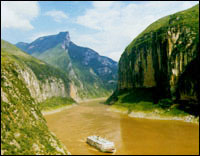
regions. Traveling eastward along the Yangtze River, one can enjoy
the magnificent Three Gorges. Every year from May through June,
the Three Gorges International Travel Festival is held in Chongqing.
Evening Scenes of Chongqing
The Red Star Pavilion in the Pipasha Park, the
Kansheng Pavilion in the Eling Park, and a place called Yikeshu
on the Nanshan Mountain are vintage points for observing the nocturnal
scenes of the mountain city of Chongqing. At night the entire city
is inundated in an ocean of lights, which form a colorful three-dimensional
painting, with waves of the Yangtze and Jialing rivers glistening
against the moonlit, star spangled sky.
Martyrs' Mausoleum at Mount Gele
The former headquarters, radio station and prison
of the Bureau of Investigation and Statistics of the Military Council
(a colossal secret service of the Kuomintang) at the foot of the
Gele Mountain in Shapingba District have become the mausoleum for
those who died a martyr's death there in China's dark days. In the
dying years of World War 11, it was the site of the "Sino0US Institute
for Cooperation in Special Technology".
Dazu Grottoes
The Dazu Grottoes in the county of the same name
is best known for the stone carvings on the Baodingshan and Beishan
mountains, which are fine example of grotto sculpture in the late
years of Chinese feudalism. The sculptures, done in fastidious chisel
work and gracious imagery, are marked by a new sculptural language
that eschews religious taboos and espouses true life.
Yangtze River's Three Gorges
Sailong down the Yangtze from Chongqing to Yichang
allows visitors to see the spectacular scenery of the Three Gorges
along with its splendid cultural heritage and fabled local folklore.
The cruise, which combines sightseeing with scientific, artistic
and folklore exploration, is a national-caliber tourist program.
The 193-km-long Three Gorges, consisting of the majestic Qutangxia,
statuesque Wuxia and ferocious Xilingxia gorges, is one of and ferocious
Xilongxia gorges, is one of the world's major canyons. Along the
way there are such scenic attractions as the Fengdu Mountain. Baidi
city, Shibao village, Zhang Fel's Temple, Qu Yuan's Temple, and
the Three Gorges Dam.
Lesser Three Gorges
The Daning River is the largest Yangtze tributary,
which rises in the southern side of the Daba Mountain and flows
for 250km before emptying itself into the Yangtze at the western
entrance to the Wuxia Gorge. The Lesser Three Gorges on the Daning
River, a 50km-long affair covering the Longmenxia, Bawuxia and Dicuixia
gorges in the lower reaches of the river, is billed as one of China's
40 best scenic resorts thanks to its gorgeous mountains, elegant
peaks, turbulent rapids, limpid water, exotic rock imagery and serene
scenery.
Jinyun Mountain
Nicknamed "Less Mount Emei", Jinyun Mountain is
a national scenic resort 55km from downtown Chongqing.
Furong Cave, Wulung
The Furong (Hibiscus) Cave is located by the Furong
River in Wulung County. The main part of the cave is 2,700 metres
in length and 3.7 square metres in area. The Splendid Cave is the
most impressive. Housed in it are nearly 30 varieties of stalactites
chiseled into every manner of exotic imagery by the cunning labor
of nature. Major attractions are Gold Throne Hall, Leifeng Pagoda
and Sky-reaching Jade Pillar.
|