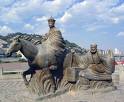
Lanzhou is not only the geometrical center of China but also a
center in the northwest in terms of transportation,
telecommunication and the Silk Road Tourism Ring. Covering an area
of 1631.6 square kilometers (629.96 square miles), Lanzhou is home
to a population of 3.14 million, including Han, Hui, Bao’an,
Dongxiang, Tibetan, Yugu and Sala and more.
Lanzhou used to be a key point connecting the central China and the
western region as well as a vital city on the Silk Road. Today,
Lanzhou is a hub of the Silk Road, with Maiji Caves to the east,
Bingling Thousand Buddha Caves to the west, Labrang Monastery to the
south and Dunhuang Mogao Caves to the north.
With mountains in the south and north of the city and the Yellow
River flowing from the east to the west, Lanzhou is a beautiful
modern city with both the grand beauty of northern cities and the
prettiness of southern cities.
The Landscape along the Yellow River should not be missed, as
Lanzhou is the only provincial city through which the Mother River
runs. Whether you choose to roam along the River, to cross the First
Bridge over the Yellow River, or to have a cup of eight auspicious
teas at the Watermill Park, you will be impressed by Lanzhou with
its harmonious combination of the modern and the old.
Chengguan, Qilihe, Xigu, Honggu and Anning are the five districts
comprising Lanzhou's downtown. Chengguan District, situated in
eastern Lanzhou, is the center of politics, economy, culture,
scientific research and transportation. In northwestern Lanzhou,
Anning District is the economic development zone as well as the area
where most colleges are located. Zhongxin Square, also namedA symbol
structure of the city Dongfanghong Square is the largest in Lanzhou
situated in the central area of the city. There is Dongfanghong
Department Store in the south, Guofang Shopping Center in the east
and Lanzhou Gym sitting in the west. The square is the daily
entertainment place for local people and is also an ideal shopping
area for tourists. The popular commercial streets in Lanzhou are
mainly Qingyang Lu, Zhongshan Lu, Jiuquan Lu, Zhangye Lu, Yongchang
Lu, Qin'an Lu, Longxi Lu and Linxia Lu, etc.
While the natural parks around the city such as Yan Tan Park and
Shifogou National Forest Park will restore and refresh you, the
White Pagoda Park and the Five-Spring Mountain Park will give you an
understanding of the cultural side of Lanzhou.
If you want to experience something more exciting, the Bingling
Thousand Buddha Caves, Labrang Monastery and Sangke Prairie should
satisfy you thoroughly.
Besides the above-mentioned attractions, the hospitable locals,
multifarious restaurants, cheap yet delicious snacks, and convenient
transportation system will all ensure that you get a memorable trip
in this tolerant and placid city.
Tips: The local snack, Lanzhou Beef Noodle (Lanzhou Niu Rou La Mian)
is highly recommended.
Five-Spring Mountain
Located at the northern foot of Gaolan Mountain in Lanzhou,
Five-Spring Mountain is 5,250 feet above sea level. It was so named
because there are five springs in the mountain. Chongqing Temple is
symbolic of the traditional architecture in the early Ming Dynasty
(1368-1644).
Labrang Lamasery
Located in western Xiahe County in Gansu Province, Labrang Lamasery
can be reached by a 5 to 6 hour drive south from Lanzhou. The
lamasery was built in 1709 in the 48th year of the reign of Emperor
Kangxi of the Qing Dynasty. It is one of the six largest religious
temples of the Gelug Sect of China's Lamaism, second only to Potala
Palace in Lhasa at Tibet. The lamasery covers 202 acres and has more
than 10,000 halls and accommodates over 3,000 lamas.
Jiayuguan Pass
Jiayuguan Pass is famous because it is the western ending point of
the Great Wall. Jiayuguan City is located at the central part of the
Hexi Corridor. Jiayuguan Pass was an important strategic spot in
ancient times. It has been a magnificent pass for over 160 years.
Although it is a booming industrial city now, there are many rich
tourist resources, for example the Jiayuguan Pass, the Suspended
Great Wall, and the Great Wall Museum. Other attractions include the
Mural Tomb of the Kingdom of Wei and Jin Dynasties, Qiyi Glacier and
Jiayuguan Glide Range.
The Suspended Great Wall
The Suspended Great Wall was called the West Great Wall in the past.
It is 5 miles north of Jiayuguan Pass and was built on the east side
of Heishan Mountain in 1539, which was the 18th year of Jiajing's
reign of the Ming Dynasty. The walls were made of compressed earth.
In some places the wall is almost vertical so that it has been
called the Cliff Wall.
Lanzhou tourist attractions:
Lanzhou-Bingling-Thousand-Buddah-caves
Lanzhou-Maiji-Caves
Lanzhou-Yellow-River
Lanzhou-Five-Springs-Mountain Park
Lanzhou-Gansu-Provincial-Museum
Lanzhou-The-First-Bridge-Over-the-Yellow-River
Lanzhou-Waterwheel-Garden
Lanzhou-White-Pagoda-Park
|